
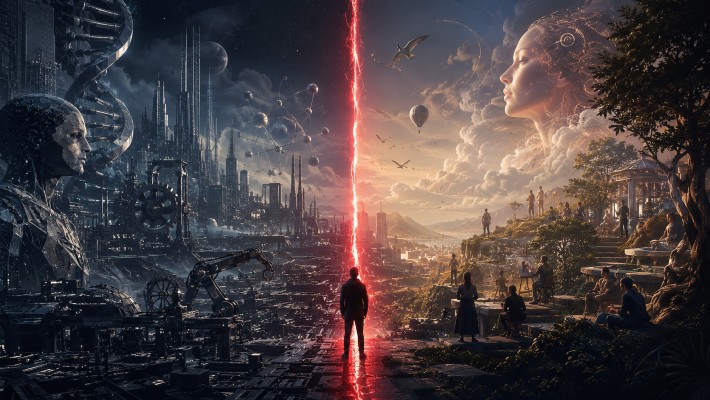
There is a bright red line running through modern society.
It does not divide people perfectly by party, class, education, or religion. Those divisions exist, of course, but this one runs deeper. It separates two basic views of life.
On one side are people whose assumptions begin with STUFF: matter, energy, space, time, biology, chemistry, economics, and the physical conditions of life. On the other side are people whose assumptions begin with LIFE: consciousness, purpose, meaning, intention, morality, and the possibility that the physical world is not the whole story.
Each side tends to find the other almost impossible to understand. One side hears talk of spirit, purpose, or non-physical causality and suspects fantasy. The other side hears that human beings are only biological machines and feels that something essential has been left out.
This conflict is not merely political. It is philosophical. And philosophy matters because philosophy defines the truths and principles by which we live.
A person’s philosophy is not an abstract ornament. It shapes what that person thinks life is, what human beings are, what counts as good or bad, what governments are for, what freedom means, what responsibility means, and whether human life has any real purpose.
That is why this divide matters so much.
The question underneath the conflict is simple: Is the senior reality of life STUFF, or is the senior reality of life LIFE?
For most of human history, people assumed that the senior reality was spiritual. They may not have understood that reality well. They may have argued about it, distorted it, or used it badly. But most cultures still held some version of the idea that life had a spiritual dimension and that moral codes were tied to something deeper than personal preference.
Religion and philosophy carried much of that burden. They tried to answer the largest questions: What is life? Why are we here? How should we live? What is true? What is good?
But religion and philosophy also had problems. Too often, important questions were answered with “take it on faith,” “the book says,” “the teacher said,” or “the tradition says.” That may satisfy some people, but it does not satisfy everyone. It certainly does not satisfy the person who wants to look, test, reason, and understand.
Then science arrived with a different discipline. Its great demand was: show me.
If something is there, let us observe it. If an idea is true, let it survive contact with evidence. If an explanation works, let it make predictions and produce results.
That discipline changed the world. It gave us technology, medicine, transportation, communication, and a level of physical mastery earlier generations could hardly imagine.
But the success of science led many people to take one step too far. Because physical evidence was so powerful, they began to believe that only the physical was real. Because STUFF could be measured, they began to assume that nothing beyond STUFF could be known, or even exist.
That assumption produced a new philosophy: materialism.
Materialism has delivered many useful insights. It has also produced some serious dead ends.
What happens if the senior reality of life is STUFF?
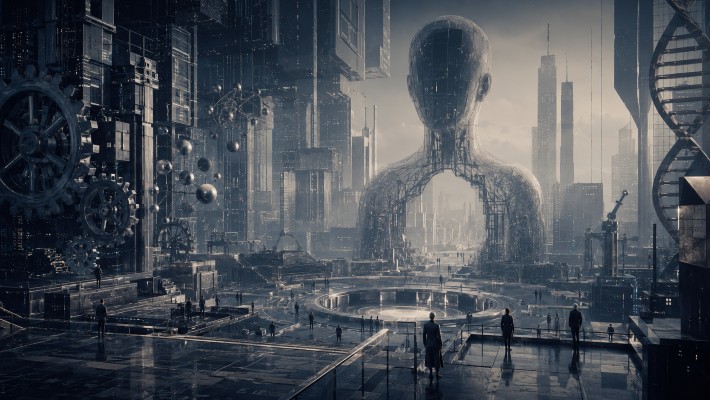
Suppose there is nothing but matter and energy. No God. No life force. No spiritual dimension. No underlying purpose. No consciousness except as a byproduct of brain activity. The universe appears, matter arranges itself, life develops, nervous systems become complex, and consciousness somehow emerges from the machinery.
There are intelligent people who believe this. They have arguments, theories, and evidence they consider sufficient. But we should also look at where that worldview leads when it becomes the guiding assumption of a culture.
If STUFF is all there is, then human beings are highly intelligent animals living brief lives on a small planet in a vast, indifferent universe. Life may be interesting, pleasurable, painful, or dramatic, but it has no inherent meaning. The universe does not care whether we exist. It does not care what we do. It does not care whether we suffer, flourish, build, destroy, love, or hate.
Meaning, in that model, becomes something we invent to make ourselves feel better.
Purpose becomes subjective.
Ethics become negotiable.
Good and bad become difficult to define except in terms of preference, utility, comfort, or power.
Some people respond to that by trying to enjoy themselves while they can. Others try to reduce suffering through material means. Others pursue money, sex, status, control, comfort, or influence. Some become compassionate materialists. Some become cynical materialists. Some become dangerous materialists.
The issue is not that every materialist becomes immoral. That is obviously false. Many people with materialist beliefs are decent, caring, responsible people.
The deeper issue is that materialism has difficulty explaining why any moral obligation should be binding in the first place. If we are only temporary arrangements of matter, why should one arrangement of matter owe anything to another? Why should sacrifice be noble? Why should cruelty be wrong beyond the fact that we dislike it? Why should truth matter if a lie produces apparently better personal results?
A culture can borrow moral capital from older religious or philosophical traditions for a while. It can keep using words like dignity, justice, rights, and freedom after it has forgotten where those ideas came from. But borrowed capital eventually runs low.
When the spiritual dimension of humanity is denied, society tends to look for purely physical solutions to human problems. If people are unhappy, redistribute resources. If people are angry, rearrange institutions. If people are lost, change the external conditions. If people are unequal, impose a new structure.
External conditions matter. Poverty, illness, injustice, and disorder are real. A serious view of life cannot ignore them. But a purely material view keeps trying to solve spiritual and moral problems with physical tools alone.
That is one reason heavily materialist political systems so often disappoint. They promise to repair humanity by rearranging property, status, or power. They assume that if the external structure is corrected, the deeper human problem will resolve itself.
History has not been kind to that assumption.
A society built only on STUFF may produce technology, wealth, and control. But it struggles to produce meaning. It struggles to explain morality. It struggles to honor the full reality of the person. And without meaning, morality, and human dignity, even prosperity becomes strangely hollow.
What happens if the senior reality of life is LIFE?
Now consider the other side of the line.
Suppose consciousness is not an accidental byproduct of matter. Suppose LIFE is fundamental. Suppose the physical universe is not the whole of reality, but an expression of something deeper. Suppose human beings are not merely intelligent animals, but beings who participate, in some way, in the creation and direction of life.
This does not require us to abandon science. It requires us to widen the question.
Science itself has already shown us that the physical world is stranger than the old materialist model allowed. The twentieth century forced open questions about observation, uncertainty, incompleteness, and the limits of what can be proven from inside a system. The old clockwork universe is no longer enough.
Some thinkers have begun to suspect that consciousness may not be a late accident in the universe, but something more basic. That possibility changes everything.
If LIFE is senior to STUFF, then human beings are not meaningless organisms drifting through a meaningless cosmos. We are participants. We are not powerless tenants in a universe that does not care. We are, in some real sense, involved in what the universe is becoming.
That gives life meaning.
It also gives life purpose.
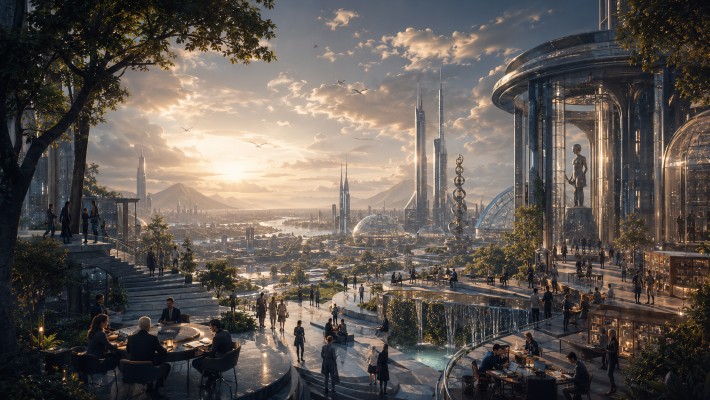
The purpose of LIFE is more LIFE: not necessarily more life forms, but better life, richer life, greater understanding, more beauty, more affinity, more awareness, more freedom, more constructive action. We may express this poorly. We may get confused. We may act against it. But underneath the noise, most sane people want life to improve.
This also gives ethics a foundation. Actions that enhance LIFE are good. Actions that reduce, degrade, or destroy LIFE are bad. That does not solve every moral question instantly, but it gives us a direction that is more workable than personal preference or raw power.
It gives us a reason to build.
It gives us a reason to tell the truth.
It gives us a reason to protect freedom, because LIFE requires room to act, choose, learn, create, and grow.
It gives us a reason to oppose crime, cruelty, and suppression, because those things reduce the life and potential of others.
It also gives us a better way to think about government and economics. The purpose of government should be to benefit the governed, not to own them. The purpose of an economy should be to make life better for as many people as possible, not to reduce human beings to units of production or dependency.
Freedom matters because people are not cattle. They are conscious beings with purposes of their own. They need enough order to live together and enough liberty to pursue constructive purposes.
A society grounded in LIFE will still need laws, institutions, science, economics, and practical systems. It will still need to solve physical problems in the physical world. But it will not confuse those systems with the whole of life.
The contrast can be stated simply.
If STUFF is senior, life tends toward meaninglessness, moral confusion, control, and the reduction of human beings to physical units.
If LIFE is senior, life can move toward meaning, responsibility, freedom, creativity, morality, and human dignity.
That is the human experiment.
We are testing which worldview can sustain civilization.
There is a problem, though. Many people are unwilling to look at any non-physical possibility. Some reject it before inspection. Others glance at it only long enough to dismiss it. But the heart of the scientific method is not dismissal. It is the willingness to look.
To look fairly.
To look directly.
To look without deciding in advance what must be true.
This may be the make-or-break point of our civilization. Are we willing to look at all the evidence, including evidence that does not fit the old materialist frame? Are we willing to ask whether the physical universe points beyond itself? Are we willing to reconsider what human beings are?
Science is one of humanity’s greatest legacies. Reason is one of our greatest tools. We should use them fully. But using them fully means not using science as a shield against uncomfortable possibilities. It means using science as a disciplined method of discovery.
The answers to some of humanity’s oldest questions may be closer than we think.
But we have to look.
The human experiment is still underway. One path reduces us to STUFF and leaves us searching for meaning in a universe that cannot provide it. The other recognizes LIFE as fundamental and opens the door to purpose, responsibility, freedom, and a better civilization.
The choice matters.
And we are making it every day.