

The other day, I saw a bit of a video whose purpose was to explain Gödel’s Incompleteness Theorem (more on that below). Kurt Gödel was a mathematician and logician who was Einstein’s best buddy at Princeton. The opening image of this video was that of a city skyline representing the structure of math, but one where all the buildings had big round holes in them. The idea conveyed was that the apparently solid foundations of math had been shown by the Incompleteness Theorem to have giant holes in them.
Back in the late 19th and early 20th centuries, following the trends of their time, the leading mathematicians of that period set out to establish that math was a complete system. They wanted to show that math was a comprehensive proof and reflection of an objective reality. By objective reality was meant that the universe exists “out there,” independent of any judgment, perception or interpretation, separate from any life forms or creative impulse. The idea of objective reality means that the physical universe we see exists, is real, is the only reality, that we can observe it, and that everything can be explained in terms of this observable reality.
They wanted to show that math would open the door to answering all questions and would validate the objective reality they were sure existed. They tried hard and got close to that goal, but ultimately failed. The closer they got to being able to close the loop on the system, the more the final target receded from their grasp.
Interestingly, this mirrored what was happening in the physical sciences around that same time. Toward the end of the 19th century, scientists felt that, by relying on classical physics and its objective reality, they had it all figured out, could explain everything, and that there were only a couple of loose ends left to clean up. Seeing physical reality as the ultimate reality upon which all else depended was the philosophy that seemed to be winning the day. That philosophy was materialism. However, those few loose ends kept stubbornly evading resolution.
As the mathematicians were trying to figure out why their desired outcome kept eluding them, Gödel published his two incompleteness theorems in 1931. This was during the same time when scientists were starting to solidify quantum mechanics, with its inherent challenges to classical physics and the concept of objective reality. The incompleteness theorems showed why the mathematicians weren’t able to close the loop on math as a complete system. In plain English, Gödel showed that any sufficiently strong formal system — one capable of expressing arithmetic — cannot prove every truth from within itself. Such systems must rest on rules or fundamental principles, called axioms, that cannot themselves be fully proven from inside the system. The thing is (and was) that almost all the systems we use or are familiar with use logic and quantities, meaning they are systems in which numbers work and which operate according to some set of rules. In that sense, this universe can be viewed as one such system.
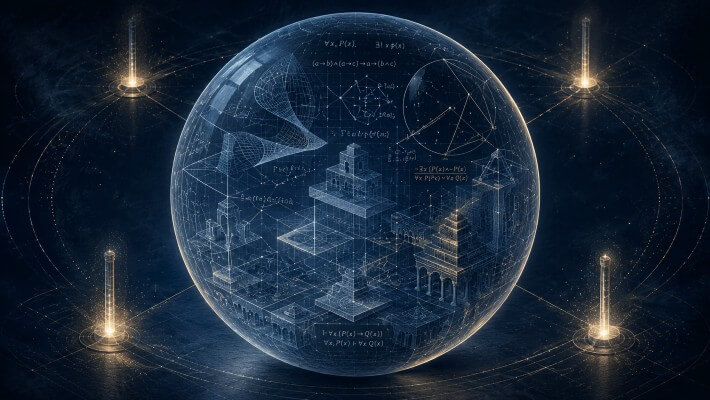
This was not welcome news because it made the inadequacy of a strictly materialistic way of thinking evident, and materialism was (and continues to be) the worldview underlying most of the thinking of the world’s scientists and intellectuals. As a result, it’s taken a while for people to really begin to grapple with its meaning and implications.
Gödel’s theorems suggested that an objective physical reality, as it was conceived by the mathematicians and scientists of the day, could not be closed off as a self-contained explanation. They showed that there had to be some sort of existence that, in some way, transcended this universe — and that the rules for this universe had to have been laid down in some way “prior” to it, or “outside” it.
That pried open the door to metaphysics — a door that mathematicians and scientists believed had been slammed shut some decades, if not centuries before. For many, the word “metaphysics” had come to mean some sort of squishy and objectionable mysticism. However, the true definition of metaphysics is “that branch of philosophy that examines the basic structure of reality.”
The door to metaphysics had been slammed shut in the past because, while knowledge about the physical universe was certain and could be validated, metaphysics had degenerated into a mishmash of contradictory notions, weird ideas and superstitious claptrap that demanded a sort of unthinking belief. More importantly, no metaphysical system ever devised by humanity had ever really worked, long term. Some of its stuff was useful or valuable for a while, but it all seemed to eventually either weaken and die or lead off into some unworkable dead end (for example, Aztec human sacrifices — a very dead end). On the other hand, physical universe data was solid, respectable and worked. You could make workable technology from physical universe data. For anyone who thought “rationally,” it seemed like all you could make with metaphysics was dubious dogma and rituals.
While this viewpoint partakes of some truth, it ignores the fact that all science and math ultimately had their roots in metaphysics. Where did Euclid’s common notions come from? Or the definition of knowledge? These ideas (along with all the other ideas underpinning science and math) came from metaphysics. Though metaphysical in origin, these ideas were able to be validated as useful and workable by experience and experiment, as opposed to owing their acceptance to some sort of authority.
One downside of relying on physical data as the only reputable source of knowledge was that all sorts of really important questions would not only go unanswered — they would be unanswerable. As ethnobotanist Terence McKenna once put it, “Modern science is based on the principle: ‘Give us one free miracle and we will explain the rest.’” But — what about that necessary miracle? Are we supposed to just ignore that? Not only is that an issue, but given recent developments (as of 2024), the number of miracles needed to explain everything may have increased. In any case, it should be obvious that any system that purports to be rigorously rational, yet depends on at least one fundamental miracle in order to hang together, could be said to be lacking — or incomplete. In order to start to be able to answer the really important questions, we’re going to have to do better.
Gödel established that there are and can be no proofs in this universe for Euclid’s common notions. Yet lots of our highly workable math is based on them, and that which isn’t is based on other similarly unprovable ideas. In fact, all of our workable theories and technologies are based on ideas that have their origins in metaphysics and have been validated in use.
So — we have to be able to figure out how to do something useful with metaphysics. But how? What can we do to carefully examine the basic structure of reality (metaphysics) while not diving off the deep end as have almost all of our predecessors?
In looking this over, we’ve established a few things:
- That the physical universe cannot be the be-all and end-all of all existence;
- That the rules underlying this universe have to come from somewhere outside or beyond it; and
- That ideas stemming from metaphysics are needed and can be useful, but only so long as they can be validated in practice.
All in all, it seems there may be more to reality than meets the eye.
This was driven home by the revolutionary discoveries in atomic physics. Once the pioneers of this area sorted out their startling and wholly unexpected experimental results, they came up with some theories and explanations that eventually meshed with existing physical theories and explained a lot of what was going on.
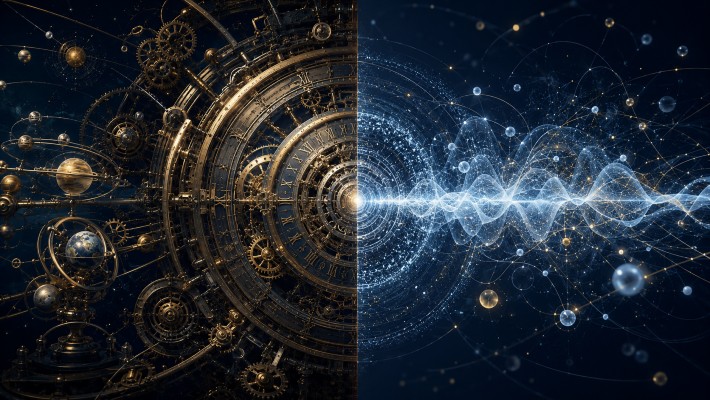
However, none of these theories really explained all of what was going on, each of them leaving substantial holes between observed phenomena and theory. Each of them had its own gaggle of mysteries, paradoxes and loose ends that its advocates just had to accept as “something which we hope to figure out someday,” if at all. The real problem was that these theories were all trying to explain what they were seeing using only materialistic ideas. However, limited to the principles of materialism, they would never be able to explain the odd phenomena they were seeing, any more than a flat-earther would be able to realistically explain how somebody could sail west and eventually end up to your east.
So, humanity has had to go back to the well of metaphysics, but this time, do so in a controlled and disciplined manner. We had to come up with a new idea that could be tested against reality and experience, and when done, could be seen to work. While working with metaphysics may seem tricky, mysterious or even dangerous to some, it’s really not all that hard if you’re careful and just obey the rules taught to us by math, logic and science.
Essentially, the puzzle was worked by looking at how reality as we know it was being rendered, and then reverse-engineering it to figure out what could have rendered it that way and how. It’s a little bit like coming across a house in an area that had been “known” to have always been uninhabited. Since nobody has ever seen a house grow by itself in the middle of a plot of land, you have to revise your theory about the place having always been uninhabited and presume that somebody built it there. You look at the house and see that it’s made of pieces of wood held together by steel spikes that were sharp on one end and had a flat head on the other — nails. From this, you reason that this somebody had to have created a tool designed to pound these spikes into the wood using the flat head as a pounding surface. From there, you reason that the easiest and most straightforward way to do this was a tool with a handle that could be used as a lever and a solid weight on one end — a hammer.
We’ve done pretty much the same process with this universe and how it’s pounded together, sifting out from metaphysics a couple of pieces of data that actually hold water, and using them to come up with some workable answers about the nature of life and this universe. And it’s not like these ideas are completely new or original — decidedly not. All we’re really doing is closing the loop on some ideas that have persisted throughout the existence of humanity, using this new data from math and atomic physics to fashion the last few pieces that complete the circle, showing how it all comes together and works together.
So — what was the conclusion? What was this new/old idea? It seems that we are each non-physical individual beings, spirits if you will, who have and use minds and bodies and have the ability to know, decide, create and impel, and that we somehow have a hand in the creation of physical reality in real time. As a result, physical reality in some way reflects the totality and average of what we all think, believe and create, moment to moment. For a much more thorough explanation of this and how it works, see my book, Reality 2.0. As different or strange as it may seem, this really is the most logical explanation for the observed phenomena, as well as the one that explains the most things and answers the most questions with the fewest assumptions.
You might ask, “How could this possibly be? I don’t see any evidence of this in my everyday life.” Perhaps the best way to express this is with an analogy. Using personal computers as an example, there’s a layer of the operating system that runs on top of, and in communication with, the actual hardware of the machine. This layer is called the kernel layer. The kernel layer communicates in machine language, which nobody but software engineers and machines understand, and talks directly to the memory, the attached devices, etc. Then, there’s a separate software layer for applications, called the application layer. The applications in this layer think they’re talking directly to the memory, devices and such, but all they’re really talking to is a “picture” or simulation of that memory and those devices that is presented to them by the kernel layer, while the kernel layer handles what’s really going on. What we consider reality (our day-to-day reality) is similar to the application layer. It’s what we see and interact with, and it works fine. Our rules for dealing with it are workable rules. However, there’s another layer that runs underneath it and is more fundamental.
We’ve managed to figure out the fundamentals and language of this machine, and can now look at what that kernel layer is, what it’s doing, and how things really work. You could be dramatic about it and say that we’ve figured out “the matrix.” In any case, it gives us tremendous insight into how to make our sciences and cultures better and more robust.
Knowing the characteristics of the physical universe and the relationship of “that which creates” to “that which is created,” we can then derive the fundamental characteristics that we all possess as living beings. This gives us data about what and who we are and our relationship to this universe. Knowing that gives us insight into our true nature and the nature of our purposes, as well as the nature of this universe.
Following the path of data and logic, we come to the conclusion that we are each, basically, creatures of light, whose purpose is to bring some sort of order and beauty, in some way, small or large, to a universe characterized by chaos and decay. While it’s apparent that our lights may have changed color or dimmed with time, that’s only because we haven’t really understood the nature of the game we were playing, and thus have sustained losses — losses that can influence the way we each view our lives and purposes going forward. We’ve done a lot of dumb and unworkable things, and some of the unworkable ideas we picked up along the way may have stuck with us. However, now knowing more about how life in this universe actually works, we can derive workable definitions of good and bad, thereby bringing order into the field of ethics and allowing it to generate practical moral codes whose purpose is to generate happiness and advance humanity. We can also define truth as it applies in this universe, and from there, many doors open.
We can bring order to the social sciences by recognizing and articulating the eternal principles that underlie each of these fields of activity. To use a mathematical term, we isolate and articulate the axioms for each of these fields, making it possible for these fields to be organized as precise sciences instead of collections of some empirically derived workable data mixed in with opinions, guesswork and authoritarianism to fill in gaps in the data. Using workable axioms, we can reason and predict, sorting out true causes and bringing order into entire fields of knowledge.
We can reason out the fundamental truths, the axioms that should apply to societies and cultures, sort out what these societies and cultures should be arranged to do, and figure out how to establish governments that will forward those truths and purposes for the benefit of all (as opposed to the ego-driven fantasies of a power-mad few). We can sort out workable economic systems that will allow and promote prosperity for the broad population, instead of narrow favored classes. We can even sort out the basic truths of how we operate our bodies and how the bodies themselves operate, such that we can make them operate better and with greater health for longer (citius, altius, fortius — faster, higher, stronger).
Of course, none of this is the work of a moment. It’s in the nature of things (at least in this universe) that a change for the better will be accompanied by a certain amount of trial and travail. If you go to the gym, you don’t get strong right away — the first thing you get is work and some struggle. It’s only those workouts that leave you feeling weak and sore for a day or so afterward that truly build strength. However, the path to strength is well known. Do the work, deal with the soreness, persist on the path, and you’ll eventually arrive at a position of strength and vitality. And now, finally, the path toward human strength, human happiness and human fulfillment can be known, and that path can be made certain, needing only to be followed. It will require work, but the door is now open.
Interested?